In data science, understanding characteristics of a population starts with having quality data to investigate. While it is often impossible to collect all the data describing a population, we can overcome this by properly sampling from the population. In this note, we will discuss appropriate techniques for sampling from populations.
Censuses and Surveys
In general: a census is “a complete count or survey of a population, typically recording various details of individuals.” An example is the U.S. Decennial Census which was held in April 2020. It counts every person living in all 50 states, DC, and US territories, not just citizens. Participation is required by law (it is mandated by the U.S. Constitution). Important uses include the allocation of Federal funds, congressional representation, and drawing congressional and state legislative districts. The census is composed of a survey mailed to different housing addresses in the United States.
A survey is a set of questions. An example is workers sampling individuals and households. What is asked and how it is asked can affect how the respondent answers or even whether or not they answer in the first place.
While censuses are great, it is often very difficult and expensive to survey everyone in a population. Imagine the amount of resources, money, time, and energy the U.S. spent on the 2020 Census. While this does give us more accurate information about the population, it’s often infeasible to execute. Thus, we usually survey a subset of the population instead.
A sample is (usually) a subset of the population that is often used to make inferences about the population. If our sample is a good representation of our population, then we can use it to glean useful information at a lower cost. That being said, how the sample is drawn will affect the reliability of such inferences. Two common sources of error in sampling are chance error, where random samples can vary from what is expected in any direction, and bias, which is a systematic error in one direction. Biases can be the result of many things, for example, our sampling scheme or survey methods.
Let’s define some useful vocabulary:
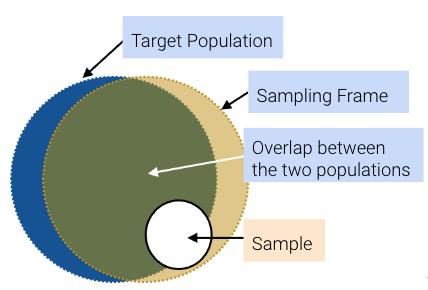
Population: The group that you want to learn something about.
Individuals in a population are not always people. Other populations include bacteria in your gut (sampled using DNA sequencing), trees of a certain species, small businesses receiving a microloan, or published results in an academic journal or field.
Sampling Frame: The list from which the sample is drawn.
For example, if sampling people, then the sampling frame is the set of all people that could possibly end up in your sample.
Sample: Who you actually end up sampling. The sample is therefore a subset of your sampling frame.
While ideally, these three sets would be exactly the same, they usually aren’t in practice. For example, there may be individuals in your sampling frame (and hence, your sample) that are not in your population. And generally, sample sizes are much smaller than population sizes.
Sampling: A Case Study
The following case study is adapted from Statistics by Freedman, Pisani, and Purves, W.W. Norton NY, 1978.
In 1936, President Franklin D. Roosevelt (Democratic) went up for re-election against Alf Landon (Republican). As is usual, polls were conducted in the months leading up to the election to try and predict the outcome. The Literary Digest was a magazine that had successfully predicted the outcome of 5 general elections coming into 1936. In their polling for the 1936 election, they sent out their survey to 10 million individuals whom they found from phone books, lists of magazine subscribers, and lists of country club members. Of the roughly 2.4 million people who filled out the survey, only 43% reported they would vote for Roosevelt; thus, the Digest predicted that Landon would win.
On election day, Roosevelt won in a landslide, winning 61% of the popular vote of about 45 million voters. How could the Digest have been so wrong with their polling?
It turns out that the Literary Digest sample was not representative of the population. Their sampling frame of people found in phone books, lists of magazine subscribers, and lists of country club members were more affluent and tended to vote Republican. As such, their sampling frame was inherently skewed in Landon’s favor. The Literary Digest completely overlooked the lion’s share of voters who were still suffering through the Great Depression. Furthermore, they had a dismal response rate (about 24%); who knows how the other non-respondents would have polled? The Digest folded just 18 months after this disaster.
At the same time, George Gallup, a rising statistician, also made predictions about the 1936 elections. Despite having a smaller sample size of “only” 50,000 (this is still more than necessary; more on this when we cover the Central Limit Theorem), his estimate that 56% of voters would choose Roosevelt was much closer to the actual result (61%). Gallup also predicted the Digest’s prediction within 1% with a sample size of only 3000 people by anticipating the Digest’s affluent sampling frame and subsampling those individuals.
Sampling Errors
So what’s the moral of the story? Samples, while convenient, are subject to chance error and bias.
Chance error (i.e., variance) occurs because random samples can vary from what is expected, in either direction. One way to reduce chance error is to increase the size of the random sample. Another option is to stratify, which we will discuss below.
Importantly, increasing sample size does not fix bias: a very large sample can still be systematically unrepresentative.
Election polling, in particular, can involve many sources of bias. To name a few:
Selection bias systematically excludes (or favors) particular groups.
Example: the Literary Digest poll excludes people not in phone books.
How to avoid: Randomly sample, and improve overlap of sampling frame and population.
Reporting/Response/Measurement Bias occurs when the desired measure differs from what is actually measured. This can happen because respondents answer inaccurately, or because the wording of a question or the measurement procedure influences the response.
Example: Illegal immigrants might not answer truthfully when asked citizenship questions on the census survey.
How to avoid: Improve questions. Lots of response bias subtypes + prevention methods.
Non-response bias occurs because people don’t always respond to survey requests, which can skew responses.
Example: Only 2.4m out of 10m people responded to the Literary Digest’s poll.
How to avoid: Increase response rate. For example, reduce the number and length of questions, incentivize completion, and follow up.
Types of Sampling
When sampling, it is essential to focus on the quality of the sample rather than the quantity of the sample. A huge sample size does not fix a bad sampling method. Our main goal is to gather a sample that is representative of the population it came from. In this section, we’ll explore the different types of sampling and their pros and cons.
A convenience sample is whatever you can get ahold of; this type of sampling is non-random. Note that haphazard sampling is not necessarily random sampling; there are many potential sources of bias.
In a probability sample, we provide the chance that any specified set of individuals will be in the sample (individuals in the population can have different chances of being selected; they don’t all have to be uniform), and we sample at random based off this known chance. For this reason, probability samples are also called random samples. The randomness provides a few benefits:
Because we know the source probabilities, we can measure the errors.
Sampling at random gives us a more representative sample of the population, which reduces bias. (Note: this is only the case when the probability distribution we’re sampling from is accurate. Random samples using “bad” or inaccurate distributions can produce biased estimates of population quantities.)
Probability samples allow us to estimate the bias and chance error, which helps us quantify uncertainty (more in a future lecture).
The real world is usually more complicated, and we often don’t know the initial probabilities. For example, we do not generally know the probability that a given bacterium is in a microbiome sample or whether people will answer when Gallup calls landlines. That being said, still we try to model probability sampling to the best of our ability even when the sampling or measurement process is not fully under our control.
A few common random sampling schemes:
A uniform random sample with replacement is a sample drawn uniformly at random with replacement.
Random doesn’t always mean “uniformly at random,” but in this specific context, it does.
Some individuals in the population might get picked more than once.
A simple random sample (SRS) is a sample drawn uniformly at random without replacement.
Every individual (and subset of individuals) has the same chance of being selected from the sampling frame.
Every pair has the same chance as every other pair.
Every triple has the same chance as every other triple.
And so on.
A stratified random sample, where the sampling frame is divided into non-overlapping strata according to chosen characteristics. Then, a simple random sample (SRS) is conducted on each stratum, with sample size proportional to stratum size.
Example Scheme 1: Probability Sample
Suppose we have 3 TA’s (Arman, Boyu, Charlie): I decide to sample 2 of them as follows:
I choose A with probability 1.0
I choose either B or C, each with a probability of 0.5.
We can list all the possible outcomes and their respective probabilities in a table:
| Outcome | Probability |
|---|---|
| {A, B} | 0.5 |
| {A, C} | 0.5 |
| {B, C} | 0 |
This is a probability sample (though not a great one). Of the 3 people in my population, I know the chance of getting each subset. Suppose I’m measuring the average distance TAs live from campus.
This scheme does not see the entire population!
My estimate using the single sample I take has some chance error depending on if I see AB or AC.
This scheme is biased towards A’s response.
Example Scheme 2: Simple Random Sample?
Consider the following sampling scheme:
A class roster has 1200 students listed alphabetically.
Pick one of the first 10 students on the list at random (e.g. Student 8).
To create your sample, take that student and every 10th student listed after that (e.g. Students 8, 18, 28, 38, etc.).
Is this a probability sample?
Yes. For a sample [n, n + 10, n + 20, …, n + 1190], where 1 <= n <= 10, the probability of that sample is 1/10. Otherwise, the probability is 0.
Only 10 possible samples!
Does each student have the same probability of being selected?
Yes. Each student is chosen with a probability of 1/10. Since there are only 10 possible samples, each sample is equally likely, and each student is in exactly 1 of the 10 samples, there is exactly 1 out of 10 possible outcomes where any specific student is selected.
Is this a simple random sample?
No. The chance of selecting (8, 18) is 1/10; the chance of selecting (8, 9) is 0.
Example Scheme 3: Stratified Random Sampling
Suppose you want to interview a representative sample of 12 students enrolled in Data 100.
Suppose there are 1,200 students in Data 100.
100 students are graduate students. The remaining 1,100 are undergraduates.
I conduct an SRS with n=1 on the 100 graduate students, and an SRS with n=11 on the 1,100 undergraduates.
Does each student have the same probability of being selected?
Yes. Each student is chosen with probability 1/100
Is there any benefit or downside to sampling this way?
Yes, a benefit! We have guaranteed proportional representation of undergrads and grad students. In other words, we have reduced chance error (i.e., variance).
There are also some limitations:
Stratified random sampling adds a layer of complexity to data analysis.
The reduction in chance error may be small when the sample size is already large and the strata are sufficiently large.
The population proportions of the groups used to form the strata are not always known.
Non-representative Sampling and Post-stratification
Often times, for whatever reason, we cannot obtain a truly representative sample. This often happens in industry.
When conducting customer surveys, not everyone responds or provides contact info
When polling for election prediction, not all voters are reachable or want to talk to you
When conducting clinical trials, patients have to voluntarily join a trial, and it is possible that people who volunteer to join a clinical trial differ in some way from the average patient who the treatment is for, and thus they are not representative of the population the trial is meant to study.
Example: Non-representative Sampling Scheme
A class has 1200 students enrolled in it, 100 of whom are graduate students, and the other 1100 of whom are undergraduate students.
The professor is trying to understand the proportion of students who are enjoying the class, and they are surveying the 20 students who are in their office hours.
In this room there are 10 grad students, and 10 undergrads.
9 of the grad students are enjoying the class, and 5 of the undergrads are enjoying the class
Based on just these 20 students, how can we make a good guess of the percentage of all students in this class who are enjoying it?
We might notice that although the number of grads and undergrads in the room is equal, across the whole class there are a lot more undergrads than grad students. We might then want to overweight the opinions of the 10 undergrads relative to the 10 grad students.
However, in order to trust this estimate, we have made a pretty huge assumption! This assumes that the 10 grad students are representative of all 100 grad students, and the 10 undergrads are representative of all 1100 undergrads.
(9 / 10) * (100 / 1200) + (5 / 10) * (1100 / 1200) = 53.3%
This is an example of post-stratification. After we took a non-representative sample (the students in professor OH) of the population we’re interested in (all students in this class), we used knowledge about the population to reweight responses.
Post-stratification: Definition
Divide your sample and population into distinct cells according to chosen characteristics (e.g. undergrad and grad).
Calculate the overall response in each sample cell (e.g. proportion enjoying Data 100)
Aggregate over the sample cells, proportionally weighing each sample cell by the size of the corresponding population cell
In order to do this, we must make some assumptions:
The population cell sizes are accurate (in the example above, we knew this, but this is not true in general!).
Each sample cell is representative of the corresponding population cell. This is a big assumption!
Demo: The 1936 Presidential Election Results
Let’s start with the real election results from the 1936 election.
Each row of
votesrepresents a single voter.voted_demis 0/1 variable indicating whether the voter voted for Franklin D. Roosevelt, who was the Democratic candidate in 1936. If 0, the voter voted for Alf Landon, the Republican candidate.
Votes for other parties are excluded from this dataset.
with zipfile.ZipFile("data/1936_votes.zip", 'r') as z:
    with z.open("1936_votes.csv") as csv_file:
        votes = pl.read_csv(csv_file)

votes.head()shape: (5, 1)
┌───────────┐
│ voted_dem │
│ --- │
│ i64 │
╞═══════════╡
│ 1 │
│ 1 │
│ 0 │
│ 1 │
│ 1 │
└───────────┘How many votes were cast for either Roosevelt or Landon in 1936?
len(votes)44430549What fraction of voters voted for Roosevelt, the Democratic candidate?
votes['voted_dem'].sum() / len(votes)0.6245897614274358But wait, don’t the slides say that Roosevelt won 61% of the vote?
Yes! But, he won 61% of all votes. If we filter to just the voters who voted for Roosevelt or Landon, Roosevelt won 62.5% of votes.
Useful tip: The mean of a 0/1 column is the same as the proportion of values that are 1.
votes['voted_dem'].mean()0.6245897614274358Of the 44,430,549 voters who voted for either Roosevelt or Landon, 62.5% voted for Roosevelt.
🎩 Simple Random Sample (SRS)
Note: An SRS is sometimes called a “names in a hat” sample, since it’s a lot like putting each observation on a slip of paper, putting all the slips in a big hat, and then randomly drawing slips one at a time.
If we were to take a simple random sample of just 1,000 voters and calculate the proportion who planned to vote for Roosevelt, how close would we be to 62.5%?
votes['voted_dem'].sample(1000).mean()0.653We can also pick the row positions ourselves. NumPy draws 1,000 random row numbers and .gather pulls out the values sitting at those positions. This is the form we’ll reuse below when we repeat the sample thousands of times.
Note that this is not an SRS. rng.integers draws each number independently, so the same voter can come up twice — it is the uniform random sample with replacement from earlier in the chapter. With 1,000 draws from 44 million voters a repeat turns up in roughly one sample in ninety, which is why the two schemes give such similar answers here.
# Construct a random number generator object.
# No need to be familiar with using NumPy this way in Data 100!
rng = np.random.default_rng()

n_votes = len(votes)

# Generate 1000 random integers from 0 to (number of votes - 1)
idx = rng.integers(low=0, high=n_votes, size=1000)

votes['voted_dem'].gather(idx).mean()0.623Both of the estimates above are pretty close to 62.5%! They are much closer than the estimate from the Literary Digest poll, which predicted that 43% of votes would go to Roosevelt.
This is no fluke! If we repeat this over and over, we tend to hover around 62.5%.
for _ in range(10):
    idx = rng.integers(low=0, high=n_votes, size=1000)
    print(votes['voted_dem'].gather(idx).mean())
0.622
0.634
0.639
0.627
0.635
0.607
0.632
0.633
0.634
0.613
Let’s randomly generate 10,000 estimates:
nrep = 10000   # number of simulations
n = 1000       # size of our sample
results = []   # list to store the sampling results

for i in range(0, nrep):
    idx = rng.integers(low=0, high=n_votes, size=1000)
    results.append(votes['voted_dem'].gather(idx).mean())

# First 10 simulated sample proportions
results[:10][0.631, 0.627, 0.63, 0.62, 0.651, 0.622, 0.617, 0.604, 0.604, 0.601]Plotting our estimates with KDE:
plt.figure(figsize=(12, 3))
p = sns.histplot(x=results, kde=True, bins=10)

# Make x-axis centered at 0.625 with 0.01 intervals
p.set_xticks(np.arange(0.625 - 5 * 0.01, 0.625 + 5 * 0.01, 0.01));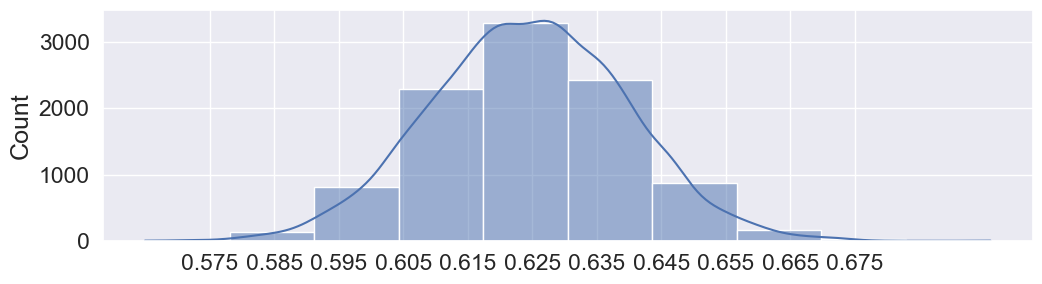
We get an approximate normal distribution centered around 62.5%, with most of the mass of the distribution (say, 95% of the mass) within about 3 percentage points (0.03) on each side.
As it turns out, with a sample size of 1000, our estimate of the proportion of voters supporting Roosevelt has a margin of error of about 3 percentage points (3pp) at a 95% confidence level (CL), so long as we take a simple random sample (SRS) of actual voters.
Note: You tend to see 3pp and 95% CL quite a lot in political polling!
We’ll learn what these values mean and how to calculate them when we (re)learn the Central Limit Theorem later in the semester.
Demo: Revisiting the 1936 Literary Digest Poll
The poll DataFrame contains a summary of the 1936 Literary Digest Poll, along with polling results and actual election results from 1932 and 1936.
Each row of
pollrepresents a U.S. state.state: name of the U.S. state.electoral_votes: # electoral votes allocated to the given state.actual_dem_1936: # votes for Roosevelt (the Democratic candidate) in 1936.actual_rep_1936: # votes for Landon (the Republican candidate) in 1936.ld_dem_1936: # Literary Digest respondents who planned to vote for Roosevelt in 1936.ld_rep_1936: # Literary Digest respondents who planned to vote for Landon in 1936.
Literary Digest also had a 1932 poll! We will use this data for post-stratification:
actual_dem_1932: # votes for the Democratic candidate in 1932.actual_rep_1932: # votes for the Republican candidate in 1932.ld_dem_1932: # of 1936 Literary Digest respondents who voted for the Democratic candidate in 1932.ld_rep_1932: # of 1936 Literary Digest respondents who voted for Republican candidate in 1932.
Note: Votes from parties other than Democratic and Republican are excluded from this dataset.
poll = pl.read_csv('data/literary-digest-summary-data.csv')
poll.head()shape: (5, 10)
┌───────────┬───────────┬───────────┬───────────┬───┬───────────┬───────────┬───────────┬──────────┐
│ state ┆ electoral ┆ actual_de ┆ actual_re ┆ … ┆ actual_de ┆ actual_re ┆ ld_dem_19 ┆ ld_rep_1 │
│ --- ┆ _votes ┆ m_1936 ┆ p_1936 ┆ ┆ m_1932 ┆ p_1932 ┆ 32 ┆ 932 │
│ str ┆ --- ┆ --- ┆ --- ┆ ┆ --- ┆ --- ┆ --- ┆ --- │
│ ┆ i64 ┆ i64 ┆ i64 ┆ ┆ i64 ┆ i64 ┆ i64 ┆ i64 │
╞═══════════╪═══════════╪═══════════╪═══════════╪═══╪═══════════╪═══════════╪═══════════╪══════════╡
│ Alabama ┆ 11 ┆ 238196 ┆ 35358 ┆ … ┆ 207910 ┆ 34675 ┆ 9828 ┆ 1589 │
│ Arizona ┆ 3 ┆ 86722 ┆ 33433 ┆ … ┆ 79264 ┆ 36104 ┆ 2202 ┆ 1679 │
│ Arkansas ┆ 9 ┆ 146765 ┆ 32049 ┆ … ┆ 189602 ┆ 28467 ┆ 7608 ┆ 1566 │
│ Californi ┆ 22 ┆ 1766836 ┆ 836431 ┆ … ┆ 1324157 ┆ 847902 ┆ 69720 ┆ 80525 │
│ a ┆ ┆ ┆ ┆ ┆ ┆ ┆ ┆ │
│ Colorado ┆ 6 ┆ 295021 ┆ 181267 ┆ … ┆ 250877 ┆ 189617 ┆ 9970 ┆ 13619 │
└───────────┴───────────┴───────────┴───────────┴───┴───────────┴───────────┴───────────┴──────────┘As a sanity check, let’s make sure we have the same number of votes as the first dataset (44,430,549):
poll['actual_dem_1936'].sum() + poll['actual_rep_1936'].sum()44430549Let’s also check that we get the reported Literary Digest prediction of 43% for Roosevelt.
Remember, Roosevelt received 62.5% of the actual vote.
poll['ld_dem_1936'].sum() / (poll['ld_dem_1936'].sum() + poll['ld_rep_1936'].sum())0.4289439704056572🥞 Post-stratification with Literary Digest responses from 1932 and 1936
Using post-stratification, let’s see if we can improve the Literary Digest poll result using the same information available to Literary Digest in 1936.
In other words, without using data from the future!
Recall the steps of post-stratification:
Divide the sample and population into cells defined by chosen characteristics.
Calculate the overall response in each sample cell.
Aggregate over sample cells, reweighting by the size of the corresponding population cell.
Sample: Responses to the Literary Digest poll from 1932, among 1936 poll respondents
Population: The actual election outcomes in 1932
Cells: Every combination of state and political party
Wait, aren’t we interested in the 1936 Literary Digest poll?
Yes! But, we can use responses from the older 1932 poll and 1932 election results to get our sample cell weights, and then use these weights to turn the 1936 poll results into a prediction of the 1936 election results.
Note that this approach assumes that over- and under-representation of voters among the poll respondents in state and party is the same in 1932 and 1936!
Let’s start with step 1. We divide our population and sample into cells defined by each combination of state and choice of party in 1932:
Cell 1: Alabama + Republican in 1932
Cell 2: Alabama + Democratic in 1932
Cell 3: Arizona + Republican in 1932
Cell 4: Arizona + Democratic in 1932
...
Note: Alaska and Hawaii were not U.S. states until after 1936.
The population cells are already in poll: actual_dem_1932 and actual_rep_1932 provide the actual vote counts for each party and state in 1932.
The sample cells are also in poll: ld_dem_1932 and ld_rep_1932 provide the number of responses to the 1932 Literary Digest poll, among 1936 poll respondents, for each party.
Let’s make the big assumption that respondents in ld_dem_1932 are representative of all voters in actual_dem_1932 for each state, and the same for ld_rep_1932 and actual_rep_1932.
In other words, we claim that response rates and outreach for Democrats and Republicans from each state in 1932 can differ, but ultimately poll respondents from a particular party+state combination are representative of actual voters for each party+state combination.
Then, we can calculate the reweighting factor, or how over- or under-represented poll respondents are relative to actual voters.
All we need to do is divide the actual vote counts by the corresponding number of respondents, for each combination of party and state.
poll = poll.with_columns(
    (pl.col('actual_dem_1932') / pl.col('ld_dem_1932')).alias('dem_reweight_factor'),
    (pl.col('actual_rep_1932') / pl.col('ld_rep_1932')).alias('rep_reweight_factor'),
)
poll.tail()shape: (5, 12)
┌───────────┬───────────┬───────────┬───────────┬───┬───────────┬───────────┬───────────┬──────────┐
│ state ┆ electoral ┆ actual_de ┆ actual_re ┆ … ┆ ld_dem_19 ┆ ld_rep_19 ┆ dem_rewei ┆ rep_rewe │
│ --- ┆ _votes ┆ m_1936 ┆ p_1936 ┆ ┆ 32 ┆ 32 ┆ ght_facto ┆ ight_fac │
│ str ┆ --- ┆ --- ┆ --- ┆ ┆ --- ┆ --- ┆ r ┆ tor │
│ ┆ i64 ┆ i64 ┆ i64 ┆ ┆ i64 ┆ i64 ┆ --- ┆ --- │
│ ┆ ┆ ┆ ┆ ┆ ┆ ┆ f64 ┆ f64 │
╞═══════════╪═══════════╪═══════════╪═══════════╪═══╪═══════════╪═══════════╪═══════════╪══════════╡
│ Virginia ┆ 11 ┆ 234980 ┆ 98336 ┆ … ┆ 16194 ┆ 6817 ┆ 12.595961 ┆ 13.14903 │
│ ┆ ┆ ┆ ┆ ┆ ┆ ┆ ┆ 9 │
│ Washingto ┆ 8 ┆ 459579 ┆ 206892 ┆ … ┆ 16223 ┆ 17122 ┆ 21.775257 ┆ 12.18578 │
│ n ┆ ┆ ┆ ┆ ┆ ┆ ┆ ┆ 4 │
│ West ┆ 8 ┆ 502582 ┆ 325358 ┆ … ┆ 10818 ┆ 11338 ┆ 37.449066 ┆ 29.17013 │
│ Virginia ┆ ┆ ┆ ┆ ┆ ┆ ┆ ┆ 6 │
│ Wisconsin ┆ 12 ┆ 802984 ┆ 380828 ┆ … ┆ 24073 ┆ 25731 ┆ 29.386034 ┆ 13.51447 │
│ ┆ ┆ ┆ ┆ ┆ ┆ ┆ ┆ 7 │
│ Wyoming ┆ 3 ┆ 62624 ┆ 38739 ┆ … ┆ 1654 ┆ 2072 ┆ 32.871826 ┆ 19.10376 │
│ ┆ ┆ ┆ ┆ ┆ ┆ ┆ ┆ 4 │
└───────────┴───────────┴───────────┴───────────┴───┴───────────┴───────────┴───────────┴──────────┘Note that dem_reweight_factor is about 36 for Arizona.
In other words, there were 36 times as many Democratic voters in Arizona than Democratic poll respondents.
Similarly, rep_reweight_factor is about 21.5 for Arizona.
So, Democratic voters are underrepresented in the 1932 Literary Digest poll responses, relative to Republican voters.
Based on the Republican bias in the Literary Digest sample discussed in lecture (i.e., wealthier folks with phones, cars, and magazines), this is expected!
Next, we apply these same weights to inflate the 1936 poll results into vote predictions.
Again, note that this approach assumes over- and under-representation patterns are the same in the 1932 and 1936 polls!
poll = poll.with_columns(
    (pl.col('ld_dem_1936') * pl.col('dem_reweight_factor')).round().alias('pred_dem_1936'),
    (pl.col('ld_rep_1936') * pl.col('rep_reweight_factor')).round().alias('pred_rep_1936'),
)
poll.head()shape: (5, 14)
┌───────────┬───────────┬───────────┬───────────┬───┬───────────┬───────────┬───────────┬──────────┐
│ state ┆ electoral ┆ actual_de ┆ actual_re ┆ … ┆ dem_rewei ┆ rep_rewei ┆ pred_dem_ ┆ pred_rep │
│ --- ┆ _votes ┆ m_1936 ┆ p_1936 ┆ ┆ ght_facto ┆ ght_facto ┆ 1936 ┆ _1936 │
│ str ┆ --- ┆ --- ┆ --- ┆ ┆ r ┆ r ┆ --- ┆ --- │
│ ┆ i64 ┆ i64 ┆ i64 ┆ ┆ --- ┆ --- ┆ f64 ┆ f64 │
│ ┆ ┆ ┆ ┆ ┆ f64 ┆ f64 ┆ ┆ │
╞═══════════╪═══════════╪═══════════╪═══════════╪═══╪═══════════╪═══════════╪═══════════╪══════════╡
│ Alabama ┆ 11 ┆ 238196 ┆ 35358 ┆ … ┆ 21.154864 ┆ 21.821901 ┆ 213283.0 ┆ 66775.0 │
│ Arizona ┆ 3 ┆ 86722 ┆ 33433 ┆ … ┆ 35.996367 ┆ 21.503276 ┆ 71093.0 ┆ 50253.0 │
│ Arkansas ┆ 9 ┆ 146765 ┆ 32049 ┆ … ┆ 24.921399 ┆ 18.178161 ┆ 189602.0 ┆ 49517.0 │
│ Californi ┆ 22 ┆ 1766836 ┆ 836431 ┆ … ┆ 18.992499 ┆ 10.529674 ┆ 1.467076e ┆ 942574.0 │
│ a ┆ ┆ ┆ ┆ ┆ ┆ ┆ 6 ┆ │
│ Colorado ┆ 6 ┆ 295021 ┆ 181267 ┆ … ┆ 25.16319 ┆ 13.922975 ┆ 252261.0 ┆ 222058.0 │
└───────────┴───────────┴───────────┴───────────┴───┴───────────┴───────────┴───────────┴──────────┘Finally, let’s calculate the proportion of predicted votes that are allocated to Roosevelt in 1936.
Remember that Roosevelt received 62.5% of the actual vote in 1936.
poll['pred_dem_1936'].sum() / (poll['pred_dem_1936'].sum() + poll['pred_rep_1936'].sum())0.542225102237559254% is a majority! Using post-stratification, we have shifted the Literary Digest prediction of a Roosevelt loss with 43% of the vote to a (correct) Roosevelt win with 54%.
There is no cheating here; we used the same data available to Literary Digest in 1936.
Note that post-stratification is not perfect. We are still off by almost 10 percentage points. But, we’ve moved in the right direction.
🎁 Bonus: Follow Up Improvements
As a follow-up exercise, we can compare the predicted 1936 vote totals to the actual 1932 vote totals.
Then, we could apply a correction factor to change the predicted number of 1936 votes to be in line with the total number of votes in 1932.
This exercise assumes that the total number of votes cast in 1932 would be the same in 1936, but the poll response rates and outreach might change between 1932 and 1936.
poll = poll.with_columns(
    (pl.col('pred_dem_1936') + pl.col('pred_rep_1936')).alias('pred_total_1936'),
    (pl.col('actual_dem_1932') + pl.col('actual_rep_1932')).alias('actual_total_1932'),
).with_columns(
    (pl.col('actual_total_1932') / pl.col('pred_total_1936')).alias('correction_factor')
)
poll.head()shape: (5, 17)
┌───────────┬───────────┬───────────┬───────────┬───┬───────────┬───────────┬───────────┬──────────┐
│ state ┆ electoral ┆ actual_de ┆ actual_re ┆ … ┆ pred_rep_ ┆ pred_tota ┆ actual_to ┆ correcti │
│ --- ┆ _votes ┆ m_1936 ┆ p_1936 ┆ ┆ 1936 ┆ l_1936 ┆ tal_1932 ┆ on_facto │
│ str ┆ --- ┆ --- ┆ --- ┆ ┆ --- ┆ --- ┆ --- ┆ r │
│ ┆ i64 ┆ i64 ┆ i64 ┆ ┆ f64 ┆ f64 ┆ i64 ┆ --- │
│ ┆ ┆ ┆ ┆ ┆ ┆ ┆ ┆ f64 │
╞═══════════╪═══════════╪═══════════╪═══════════╪═══╪═══════════╪═══════════╪═══════════╪══════════╡
│ Alabama ┆ 11 ┆ 238196 ┆ 35358 ┆ … ┆ 66775.0 ┆ 280058.0 ┆ 242585 ┆ 0.866196 │
│ Arizona ┆ 3 ┆ 86722 ┆ 33433 ┆ … ┆ 50253.0 ┆ 121346.0 ┆ 115368 ┆ 0.950736 │
│ Arkansas ┆ 9 ┆ 146765 ┆ 32049 ┆ … ┆ 49517.0 ┆ 239119.0 ┆ 218069 ┆ 0.911969 │
│ Californi ┆ 22 ┆ 1766836 ┆ 836431 ┆ … ┆ 942574.0 ┆ 2.40965e6 ┆ 2172059 ┆ 0.9014 │
│ a ┆ ┆ ┆ ┆ ┆ ┆ ┆ ┆ │
│ Colorado ┆ 6 ┆ 295021 ┆ 181267 ┆ … ┆ 222058.0 ┆ 474319.0 ┆ 440494 ┆ 0.928687 │
└───────────┴───────────┴───────────┴───────────┴───┴───────────┴───────────┴───────────┴──────────┘poll = poll.with_columns(
(pl.col('pred_dem_1936') * pl.col('correction_factor')).alias('pred_dem_1936_corrected'),
(pl.col('pred_rep_1936') * pl.col('correction_factor')).alias('pred_rep_1936_corrected'),
)
poll['pred_dem_1936_corrected'].sum() / (poll['pred_dem_1936_corrected'].sum() + poll['pred_rep_1936_corrected'].sum())0.5419440974611632Looks like a pretty similar prediction for Roosevelt of 54%.
As it turns out, it looks like our original (i.e., uncorrected) predictions had a vote total closer to the true 1936 vote total:
print('Actual 1936 vote total:')
print(poll['actual_dem_1936'].sum() + poll['actual_rep_1936'].sum())

print('Predicted 1936 vote total, uncorrected:')
print(poll['pred_dem_1936'].sum() + poll['pred_rep_1936'].sum())

print('Predicted 1936 vote total, corrected:')
print(poll['pred_dem_1936_corrected'].sum() + poll['pred_rep_1936_corrected'].sum())
Actual 1936 vote total:
44430549
Predicted 1936 vote total, uncorrected:
42058418.0
Predicted 1936 vote total, corrected:
38582531.0
Furthermore, we can check whether post-stratification would have led to a predicted win for Roosevelt in the electoral college, which is what actually determines the election outcome.
To do this, we allocate all of the electoral votes in each state to the candidate with the most predicted votes in that state, and then sum up the total number of electoral votes allocated to each candidate across states.
poll = poll.with_columns((pl.col('pred_dem_1936') > pl.col('pred_rep_1936')).alias('dem_wins'))

print('Total predicted Roosevelt electoral votes:')
print(( poll['dem_wins'] * poll['electoral_votes'] ).sum())

print('Total predicted Landon electoral votes:')
print(( (~poll['dem_wins']) * poll['electoral_votes'] ).sum())
Total predicted Roosevelt electoral votes:
380
Total predicted Landon electoral votes:
151We (correctly) predict a Roosevelt landslide in the electoral college!
But, note that the actual electoral college landslide was much bigger: 523 to 8
This is the largest electoral college landslide since 1820 (as of 2025).
Summary
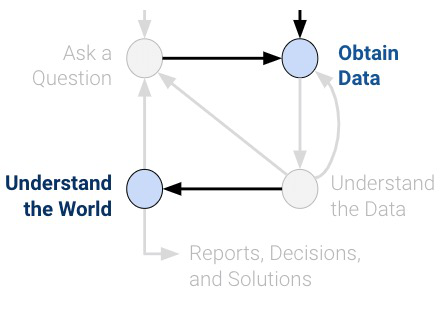
Understanding the sampling process is what lets us go from describing the data to understanding the world. Without knowing / assuming something about how the data were collected, there is no connection between the sample and the population. Ultimately, the dataset doesn’t tell us about the world behind the data.